
The full story
Disarm
A Lullaby for the Broken The word "disarm" carries an older echo. In 1870, after the American Civil War and the Franco-Prussian War had together killed hundreds of thousands, writer and activist Julia Ward Howe addressed the mothers on both sides. In her proclamation she wrote: "Disarm! Disarm! The sword of murder is not the balance of justice." The word was already a plea before it became a movement. It is that history the name of this piece steps into.

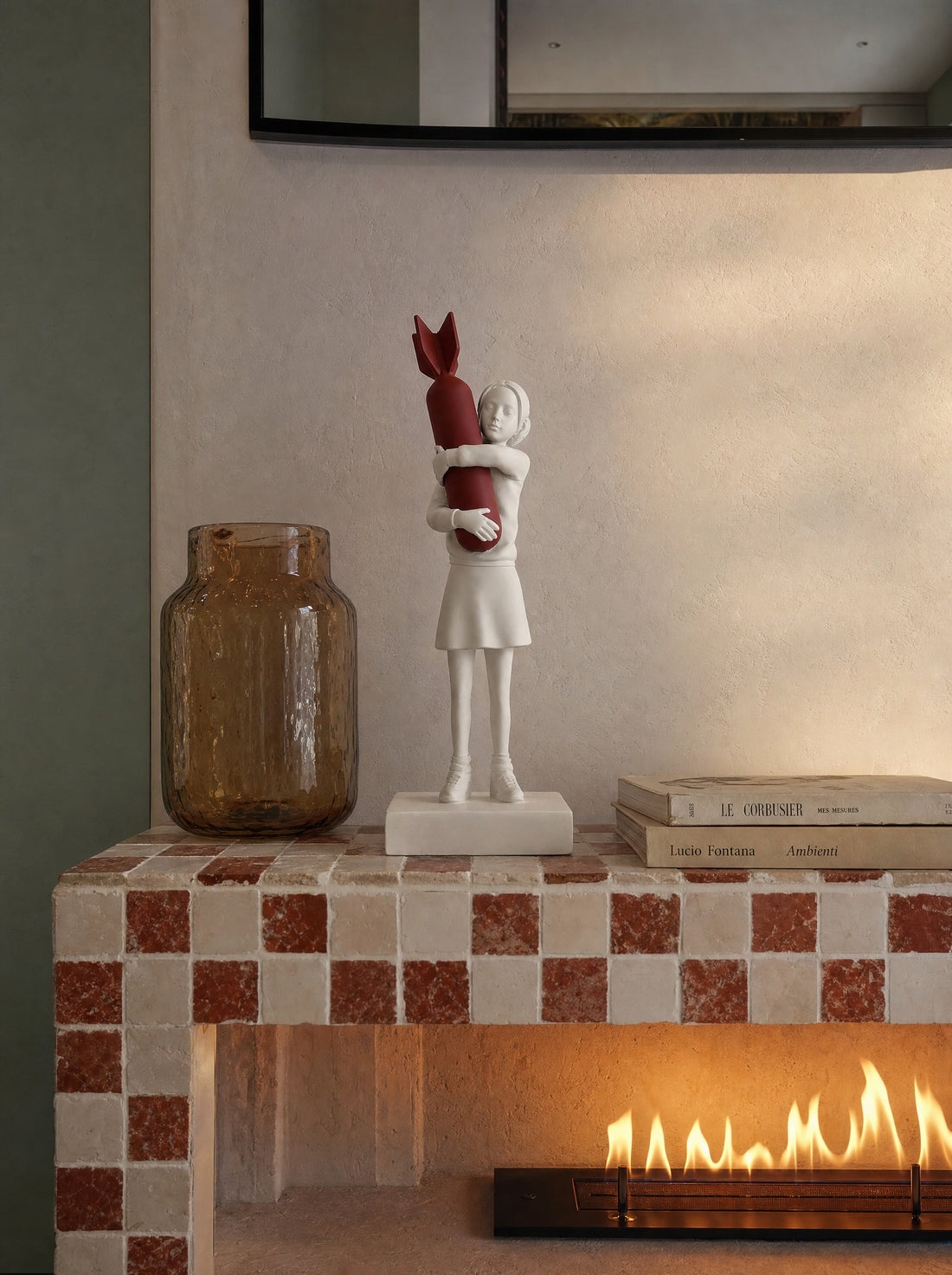
Disarm tells a quietly devastating story about the fragile boundary between devastation and hope. Set against the echoes of conflict, this piece portrays a small girl clinging to the ultimate symbol of destruction. Yet in her embrace, the cold weapon ceases to be a threat. She closes her eyes, and in her stillness, the weight of history is held rather than carried forward.
This is a piece about human resilience: the belief that even amidst suffering and loss, we retain the right to dream of a gentler world. The red of the missile is not merely a warning. It is the color of a beating heart persisting through the silence of history.

Material and Haptic Atmosphere
The White: cast in matte white, smooth and almost weightless against the gravity of the subject. White here is not absence. It is the color of something set down. The Red: a deep, grounded hue, matte rather than glaring. Not neon. More like a scar that has healed yet remains. The contrast between the two is the piece: stillness holding something that was never still. The Base: Solid marble, hand-finished. Its weight anchors what the figure above it refuses to release.
Curating Emotion
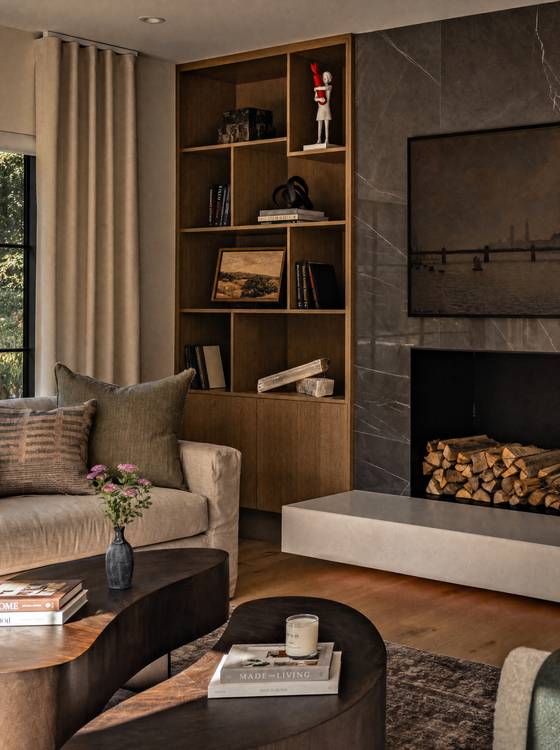
The Contemplative Corner: Place near a window in late afternoon light, or beside books that have been read more than once. Long shadows create their own kind of quiet. A Dialogue with Time: Let it stand alone on a shelf, the way a considered thought stands alone in a long conversation.
Specifications
Dimensions: 3.5" x 3.5" x 10.2" (9.5 x 9.5 x 26 cm) Material: Matte white figure on a solid marble base, hand-finished Message: Make dreams, not war.
A Deliberate Stillness
Peace holds because someone chooses to hold the weapon down.
Not the moment of victory. The moment after, when someone lowers the weapon and keeps it there.
Disarm is available now. Matte white, hand finished, set in solid marble. $68.20.


A loud noise overhead reads differently depending on what you have lived through. For some people it is nothing, just noise. For others, especially those who have stood closer to real danger than the rest of us, that same sound does not land as celebration. It lands as something already lived through. The boom, the flash, the crack in the air. They know exactly what that is.
The Soft Minimal made Disarm for the quieter want underneath that reaction: the plain, unglamorous wish for the noise to simply stop. Not a statement, not a protest. A small acknowledgment Manuela kept returning to while she designed it: peace costs something, and some people carry the weight of that cost longer than others. This piece is a gesture toward stillness.


Disarm was part of the collection once. It sold through and disappeared.
Earlier this year, the marble used for the base became harder to source. Orders came in faster than the pieces could be finished. Manuela kept production running, but the finished work was not what she was willing to stand behind. She cancelled the batch rather than ship something she did not believe in.
This version is the one she held to. Solid marble base, hand-finished, the same posture: both arms around a red missile, eyes closed, at rest. It is available now, limited only by how much marble there is.
There is a longer tradition of this.
In 1783, Benjamin Franklin wrote: "There never was a good war or a bad peace." It is one of those lines that sounds abstract until you have carried a weapon and finally put it down.
Artists have been saying the same thing ever since. A sculptor knotted the barrel of a revolver so it could never be fired again. A protester pressed a flower into the mouth of a rifle, and the image has held for more than half a century. The artist Pedro Reyes turned 1,527 guns surrendered in one Mexican city into 1,527 shovels, and those shovels planted 1,527 trees. Years later, he took a separate batch of 6,700 confiscated weapons, crushed them, and rebuilt them as musical instruments.
The gesture is always the same: take the object made for harm and give it a different life.
That gesture points toward a particular kind of world. Fewer weapons in it. People able to sleep through the night.
Every war insists it is being fought for something worth keeping afterward: a life left undisturbed, a family able to gather, an ordinary evening nobody has to prepare for. War, in that framing, is only ever the means. The peace is the point.
Manuela designed Disarm because she believed that point deserved a shape. Something you could put on a shelf and live with.

A quieter world. And the will it takes to keep it that way.

Read further
What Peace Costs
Peace is easy to describe as an absence: no war, no threat, no noise overhead. That description misses what actually holds it up. Peace is not empty space left behind after a fight. It is made, moment by moment, by someone choosing not to escalate when they easily could.
That choice is rarely dramatic. It looks like restraint instead of victory, patience instead of the last word, someone deciding that being right matters less than staying still. Almost nobody notices when it happens. Nobody notices, either, on the countless days it has to happen again.
War asks for one moment of will. Peace asks for that same moment, repeated, for as long as anyone can remember to keep choosing it.
Manuela designed Disarm as an image of that repeated choice: a small white figure holding a weapon, not firing it. Not because there is no strength in that arm. Because the strength has been redirected, entirely, toward staying still.
"Peace is not what is left after a fight. It is what someone keeps choosing instead."

The Sound of the Rocket
A rocket is built to do one thing: rise fast, burst, and be seen doing it. Every part of its design points toward impact. That is true whether it is a firework meant to dazzle a crowd or something built for a very different purpose. The sound is the same sound.
For most people, that sound is spectacle, over in a second and forgotten by morning. For people who have stood closer to real danger, the same crack and flash does not register as spectacle. It registers as memory, arriving without warning, whether they invited it back or not.
Disarm holds the other half of that image. A small figure in matte white, set on a base of solid marble, eyes closed, arms wrapped around a rocket the color of fire. Not firing it. Holding it. The way you would hold something you were trying to calm. The way you hold a child frightened of a sound they do not understand.
Not every rocket has to be answered with another one. Some are simply better held still.
"Stillness, held on purpose, is its own kind of strength."

The Work of Reconciliation
Reconciliation is not the moment two sides stop fighting. It is everything that has to happen afterward, when people who spent years working against each other have to find a way to occupy the same room, the same street, the same life again.
That work rarely gets remembered as clearly as the fighting does. It has no single date, no clear victory to mark. It asks something specific of the people doing it: to know exactly what was lost, to hold that knowledge without flinching, and to choose stillness anyway.
That kind of peace is not naive to the cost. It has simply decided the cost is not worth paying twice.
Manuela designed Disarm for the people who reach that decision. The figure holds a weapon and does not fire it, not because it has forgotten what the fighting was for, but because it has chosen, this time, to set the weight down instead of pass it on.
"Peace is not forgetting what happened. It is deciding not to repeat it."
Freedom from Fear
There is a name people have given to this particular wish: freedom from fear. Not the absence of danger everywhere, but a world reduced enough in armaments that no one has to lie awake wondering if tonight is the night it reaches their door. A world where a family can sleep straight through until morning.
That wish outlives whoever names it first. On June 12, 1982, roughly one million people gathered in Central Park in New York City, timed to coincide with the United Nations Second Special Session on Disarmament. They were calling for a freeze on nuclear weapons. They asked, peacefully and lawfully, that the nations of the world put down what they were holding.
Norman Rockwell painted freedom from fear in 1943 as a mother tucking in two sleeping children while the father stands beside her holding a newspaper with headlines about bombing overseas. The children do not know. Their eyes are closed. That image predates the Central Park march by almost forty years, and it holds the same wish: people who want, more than anything, for those they love to sleep undisturbed.
Disarm holds that same wish. The figure's eyes are closed. Not in fear. In rest. The face of someone who has put something down and is no longer carrying it.
"Unhurried moments, and a place quiet enough to have them."
The Cost of Keeping Peace
There are two different accomplishments hiding inside any peace. The first is arriving at it: getting two sides to stop, to agree, to put something down at the same time. That part gets remembered. It gets a date, sometimes a monument.
The second accomplishment is keeping it. That part rarely gets a monument, because it does not happen once. It happens every day after, in small unremarkable decisions nobody is watching: to not escalate, to not retaliate, to let the quiet continue one more day. Keeping peace asks for more patience than winning it ever did.
Manuela designed Disarm for that second, quieter accomplishment. Wanting peace is not the soft option. It is the harder one, chosen again and again, long after anyone is applauding.
"To keep something is quieter work than to win it."

A Quieter Kind of Peace
Loud celebration is easy to notice. It fills a single day, and then it is over. The wanting that actually holds a peaceful life together is quieter than that, and it lasts longer. It lives in smaller decisions: to build something, to protect someone, to come home and stay.
There are people for whom loud, sudden sounds carry more than celebration ever could. Anyone who has lived close to real danger knows, in their body, what force costs. For them, a crack or a boom overhead does not sound like a party. It sounds like something already survived. Wanting a quiet life for people who have already carried enough noise is one of the kindest things a person can want for someone else.
Manuela designed Disarm as a gesture toward that quieter want. Not a protest. Not a statement about policy. A small figure that keeps a weapon still, standing on a solid base, built to last. Something to place in a room as a reminder: that peace is worth wanting, that the people who have carried too much noise deserve to rest, and that a home worth coming back to is the point of all of it.
"Simple comforts, soft-spoken, and a home worth coming back to."




Beauty serves well-being.
The essence of Soft Minimal
Our philosophy is rooted in the belief that beauty must serve your well-being. Unlike rigid minimalism, our approach informed by Nordic discipline and Japanese tranquility seeks to amplify warmth and tranquility through restraint.
Every sculpture is crafted not just to look beautiful, but to feel right. We honor the tactile effect of natural materials and the artful balance of light and shadow, ensuring our pieces act as a meditative anchor in your space.


