

The Soft Minimal
The Senses
For human-centric artwork and design to reconcile our relationship with the world and enhance the quality of life, they should engage all senses holistically.

Sun goes through it, not around it, and lands on the shelf softer than it left the window.
$149.70
I
For a significant period of human history, the dominant philosophy drew a firm line between mind and body, insisting our mental and physical faculties were separate and favoring the mind above all else. The body was just a machine, and the senses mere servants. This ideology was applied widely across science and the arts, leading to a multidisciplinary disregard for the senses and the embodied experience of the world. As modern technologies prevailed, the idea tightened its grip, leading to a normalized sensory deprivation. Architecture and design became inhumane as they prioritized functional and intellectual aims and neglected the bodily and psychological needs of the people they were made for.

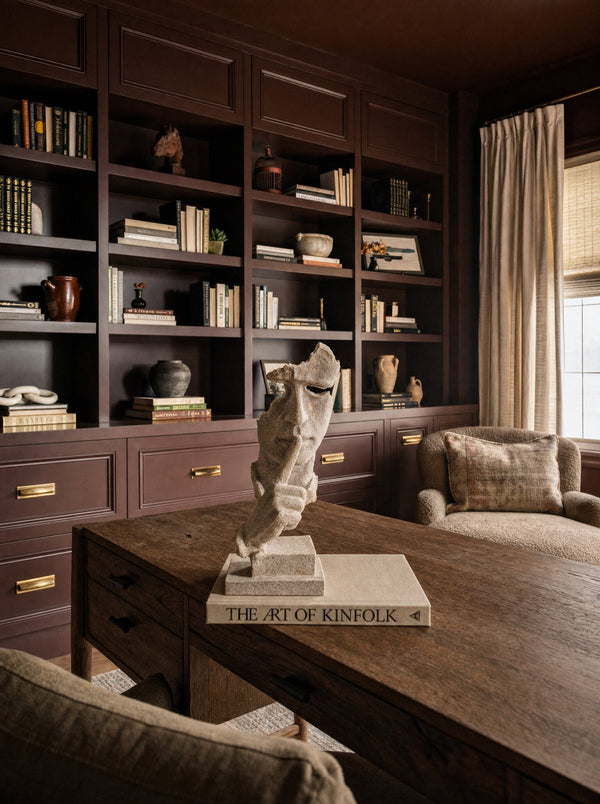
A finger held to the lips, and the whole figure speaks through the body alone.
$79.84
II
Today, many thinkers agree this desensitization has contributed to the feeling of isolation, of a spiritual void and a prevalence of illness in contemporary societies. The situation charges artists and designers with the urgent task to resensualize our relationship with the world: to use space and matter as mediators between body and mind, ultimately nurturing the whole organism.

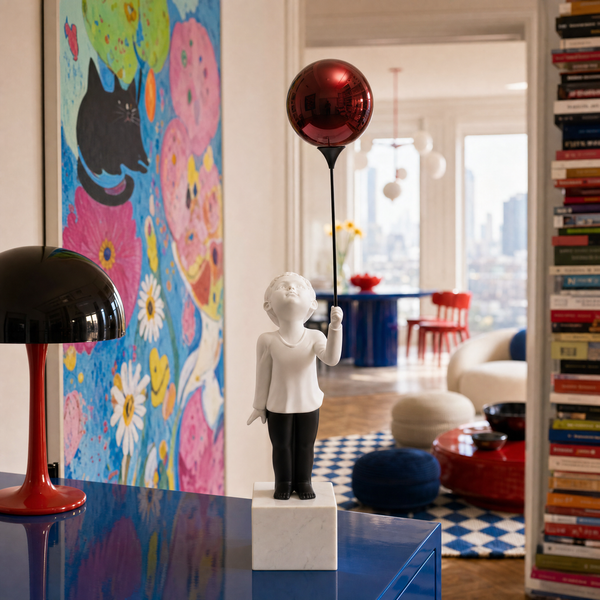
The white figure keeps the bright red shape close to its chest: disarmed by being held.
$68.20
III
Our surroundings move us deeply. Contemporary neuroscience confirms it is the senses, with their acuity for pleasure and pain, that teach us how to navigate the world. Our senses are inextricably linked to our existential experience: our feeling of being in this exact place, right now, with these particular things. Working in concert, the skin, eyes, ears, nose and tongue decode thousands of stimuli forming an immediate interpretation of, and reaction to, the environment they meet. After taking in the whole atmosphere, perception narrows its focus, using the collaborative insights of the senses to explore details of shape, surface, density, light, sound, and so on. A holistic understanding of the world derives from these inputs resonating through the body followed by the mind. The interdependent system merges stimuli from different senses, cross-pollinating a smell with a memory, an image with a movement or a texture with a certain emotion. It is a skill we practice from birth and one that eventually builds our awareness between internal and external realms. We learn to feel pleasure when our bodies resonate with a given substance or space and to feel unease in the presence of others. A lifetime of these embodied encounters remain in memory and form our unique sense of comfort, protection and home.

One mid-stride, one at rest, a grainy matte surface on both: a texture with a feeling attached.
$199.70

A striding figure, eight red balloons in hand, met every day in a room a family calls home.
$155.58
IV
For human-centric artwork and design to reconcile our relationship with the world and enhance the quality of life, they should engage all senses holistically. At The Soft Minimal, we ask ourselves, "How should this space or object make someone feel?" The answer guides the selection and arrangement of interrelated design elements, each with a sensorial role to play in their cumulative aim. The process requires that we, as designers, draw on our own embodied experience of space and matter as well as practice empathy for the human who will encounter the work. We combine our personal sensory memory with a curiosity for someone else's and through imagination, envision spaces and objects that will hopefully feel sublime. During the process, we need to simulate future events by using our whole body, predicting the elements not only through two-dimensional drawings or models but by imagining how the sounds, textures, volumes and odors will feel to the body. In this way, artwork and design is a language expressed from one human body to another.

Each marble sphere lands in the hand cooler and heavier than the eye predicted.
$266.90

One lamp: a warm pool of light for the eye, a mirrored dome and a settled weight for the hand.
$166.20
Sight
Modern society gives sight superiority over the sensory realm. Its high status has been linked with the ego, the mind, as historically preferred to the body, and with visual arts. The exponential production of images throughout time tells a story of an unhealthy obsession that is never satiated. This ocularcentrism gives the eye supreme power to shape the world based on appearances, leaving other sensory virtues behind. Within artwork and design, the functions of sight are indisputable: for calculating distance, density and weight; for perceiving light and its offspring, color, and for presupposing touch. On an emotional level, sight gifts us visions of beauty that are doubtless essential to well-being. While the visual domain deserves appreciation, it is time to restore balance between all the senses. Good design should not only look good but feel and sound good and even smell good.

A marble base below, light off the polished balloon above: the eye reads both before the hand.
$189.64

Deep brown at the far end of a pale room, the figure gives the eye its distance and weight.
$129.82
Touch
Touch is the mother of sight, hearing, smell and taste. When we are born, our first sensations are of touch through our skin. This extraordinary organ shelters our inner being, yet its boundary greets the world. It is at once our protector, informant and comforter. Our bodies are sensitive landscapes for a reason, designed to feel the ever-changing external environment to regulate the internal. We calibrate ourselves to the world through sensations of contact, of ambient temperature and humidity, of density and weight. Emotionally, touch profoundly affects our sense of safety and belonging and in its absence, we feel deprived and alone. Human-centric design is necessarily haptic, treating the skin with a spectrum of smooth, textured, hard, soft, warm and cool sensations. By harmonizing tactile qualities, a space or object can imbue intimacy, softening the border between internal and external, and inviting the human body to feel.

Smooth along every curve, two bands leave a heart-shaped opening the finger wants to trace.
$66.20

Switched off on its wooden tray, the lamp still meets the hand, its dome polished and cool.
$166.20
Sound
As with touch, how spaces sound influences how we feel. Like light, architecture reflects and absorbs soundwaves and can be arranged to amplify or soften, direct or refract. Sound creates interiority: we map the scale and material of a space by listening to reverberations. Depending on our auditory preferences, the orchestra composed by the shapes, voids and surfaces of architecture can be pleasing or painful. The echo of an empty house can evoke loneliness, footsteps muffled by wool carpet make us feel cozy and the harsh bang of metal doors might provoke stress. We have evolved to find total silence disquieting, since the natural world is always humming, and we are of the natural world, while loud noise puts us on high alert. Human-centric spaces try to conduct sounds that suggest life, allow communication to flow and ease spatial orientation. They often whisper rather than shout, fostering a sense of safety and peace.

Set it down and the marble base tells you what it is: one low knock on wood, then quiet again.
$88.20

Two figures stand quiet on the dark wood table, in a room where wool swallows every footstep.
$199.70
Scent
Scents reach into our memory, tickling it awake and rousing potent thoughts and feelings. We can walk into a family home after 20 years and, eyes closed, be transported to our childhood in an instant. Humans have developed an acute sense of pleasant and unpleasant smells to survive in unpredictable environments. A certain aroma stimulates our nervous system to trigger feelings of calm, love, fear or cleanliness. Powerful yet underappreciated in artwork and design, our sense of smell can forge lasting connections between body, psyche, space and object. This intimate sense can linger long after we have forgotten the image of a room or lost touch with the feeling of a stone artwork.

A pour held still in matte resin, an arm's length from where the smell of coffee is made.
$68.20
By harmonizing tactile qualities, a space or object can engender intimacy, softening the border between internal and external, and inviting the human body to feel.
A photo can give you the shape of a piece and little else. The weight, the temperature of the surface and the grain under a thumb only arrive when it is in your hands.
Each piece here was made for that moment, not for the photo.
Shop the CollectionSizes, finishes and photos on every product page.
From the Collection


Leave a comment
-

Returning to Nature
Over thousands of years of urbanization and industrialization, we have slowly but surely separated ourselve...
-
Soft Minimalism
We spend most of our time indoors. Our experience of everyday life is largely dependent on the man-made str...
-
The Film That Hurt Us, and Why We Keep Returning to It
The Film That Hurt Us, and Why We Keep Returning to It On Albert Lamorisse's The Red Balloon, and the stran...

Thank you for the intentionality in your thought and designs.
We find our selves nourished and grounded (as I have mentioned) mentally, physically, emotionally and spiritually … as we are the object of those intentions
It’s the personification of the Law of Attraction