The full story
Earth & Table
In Building a Story, an essay in our Journal, we wrote about the table: one of the oldest things people build, so they can sit together, talk and mark an occasion. The essay also named the materials homes have long been made from, such as wood, stone, clay and metal.
Earth & Table is what goes on top of that table, in those same materials: wood, a stone called travertine, ceramic and a metal with a brass-colored finish. Their designer is Manuela, architect and artist at The Soft Minimal.
The soft, organic shapes of the animal and plant kingdoms provide familiar forms and materials that speak to the senses. On these pieces, they become tree rings circling the inside of a bowl, a rim that waves like an open clam, a dish shaped like a peanut shell and scales that overlap like the leaves of an artichoke. Each piece carries an Italian name.
Madia: A Bread Trough for Twenty Loaves
A history museum in Pittsburgh keeps a wooden dough trough that an Italian immigrant built for his wife. She wanted to bake bread in her new home the way she had been taught in her village, so he made it big enough to hold the dough for twenty loaves.
Back in the villages they came from, families kept one at home, a madia. The women mixed and kneaded the dough in it, then left it to rise under a cloth, and the wood was left bare so it could soak up the extra water from the dough. In this way, natural materials can help us access an embodied sense of belonging to a place and moment in time.
Our Madia is a long, shallow dough bowl carved out of a single block of wood, with the marks of the gouge still running from end to end. Its surface is a soft, weathered gray-beige. On a table today, it holds a row of pears, a loaf wrapped in a napkin or the keys by the door.

When Guests Were Counted by the Tagliere
How many are coming to dinner? In old Italian, you could answer in taglieri. A tagliere is a wooden board, the kind bread and cured meats are cut on, and the old language also used the word for a place at the table: a banquet of twenty taglieri fed twenty guests, and to be at one tagliere with someone was to eat at the same table.
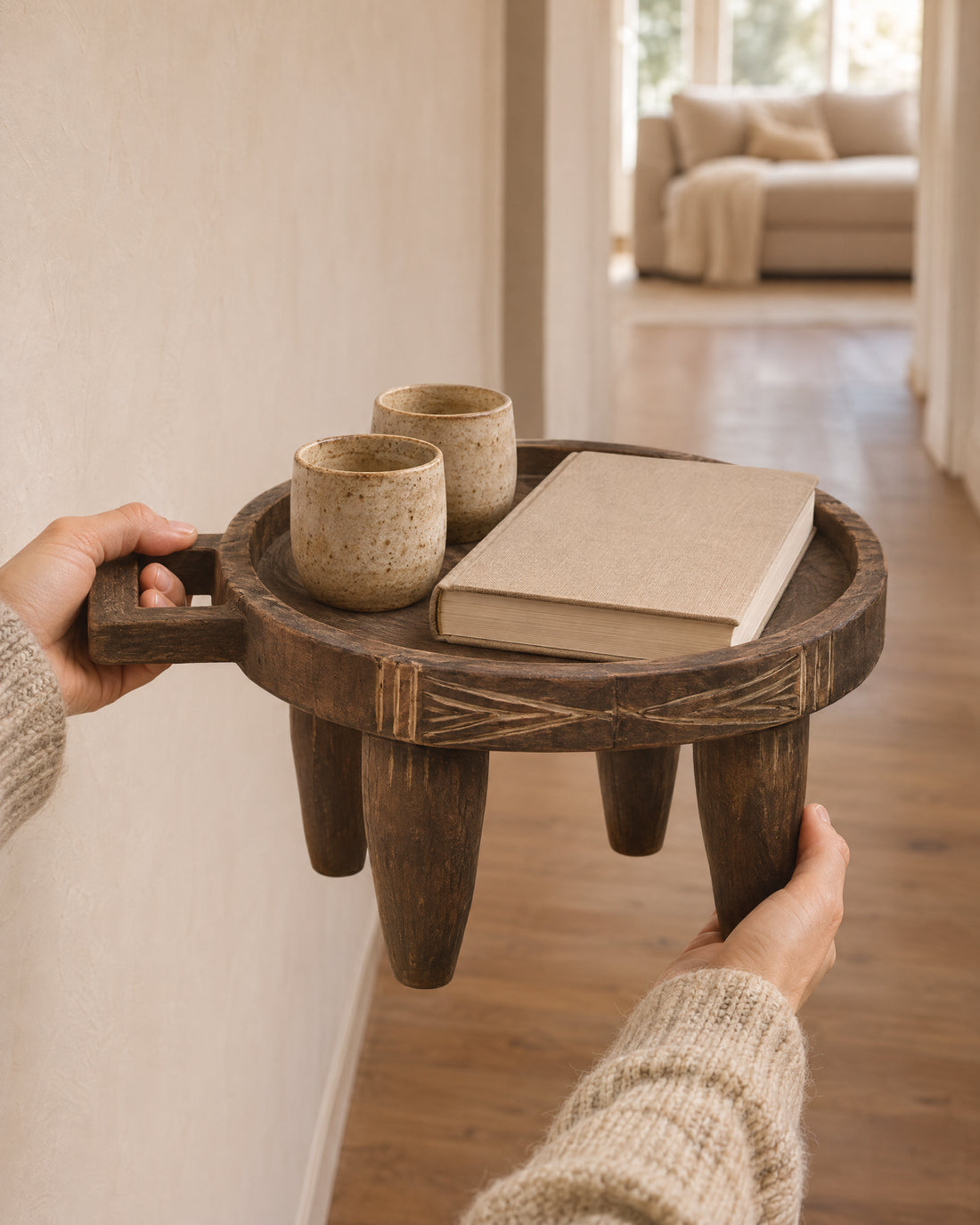
Our Tagliere is a round wooden tray that stands on four short legs, each one narrowing at the foot, like a small stool. A four-legged chair could almost grow fur. The tray also has a square handle cut right through at one side, and a band of crisscross lines carved around its rim.
It comes in a light finish and a dark one, and the grain differs on every piece. Lift it by the handle and carry it to the coffee table with two cups and a book, or leave it on the dining table to keep the salt and pepper in one place.
Scodella, the Shape of Cupped Hands
Cup your two hands together to hold water, and in Italian you have made a scodella. Italians say fare scodella con le mani: to bring the hands close and curve them so they can hold something. A scodella is a deep bowl, and the word goes back to the Latin for a little plate or wooden tray.
Our Scodella bowls keep that cupped shape, in wood and in four styles. The turned bowls come in black or brown and in three sizes; inside the black ones, the rings of the tree circle the center, one inside the next. The carved bowl is deep brown and rough from the gouge on the outside. The faceted bowl is black, with thick sides cut all over into small flat faces.
Designs crafted from wood, stone or leather will truthfully convey the perfection of their youth and the seasoned quality of midlife. Here, it shows as grain, knots and fine cracks that follow the rings, never alike from one bowl to the next. Fill the largest with whole oranges for the middle of the table, and keep a small one by the back door for keys.

Brigata: A Few Friends, a Happy Life
Poca brigata, vita beata: a few friends, a happy life. Italians use the proverb to say that a few good people are company enough. A brigata is a group of friends or relatives who meet to spend time together cheerfully, and in older Italian the word also meant one's own family, the people one sat down to dinner with.
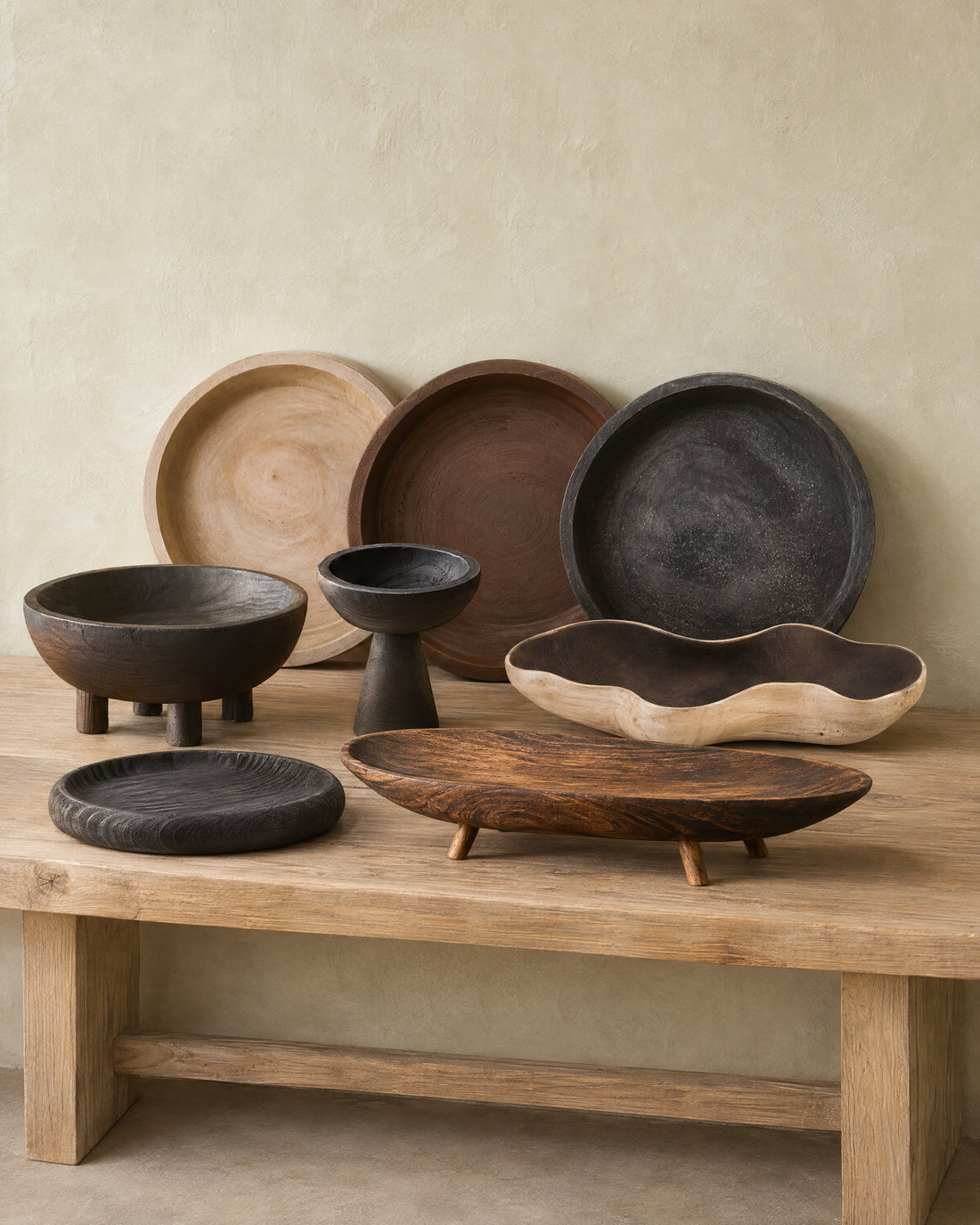
Our Brigata is a small group of its own: eight pieces in six shapes, each sold on its own, all in the same aged, matte wood finish. There are round trays in natural wood, brown or black, a low black tray almost as flat as a plate, a deep bowl on four stout legs, a small cup raised on a tall cone, a boat-shaped dish on slim pegs and a peanut-shaped dish, dark inside and pale at the edge.
Two or three are enough. A cluster of forms with little space between them signifies abundance and intimacy. Set the footed bowl beside the tall cup on a coffee table, with whole fruit in one and jewelry in the other, and let a round tray hold the keys.
Rigato, Ridged or Smooth
Buy penne in an Italian grocery and you will find two kinds side by side: rigate, with ridges down the sides, and lisce, smooth. The ridged kind takes its name from rigato, marked with lines, and so do rigatoni, short tubes ridged all around the outside with deep grooves.
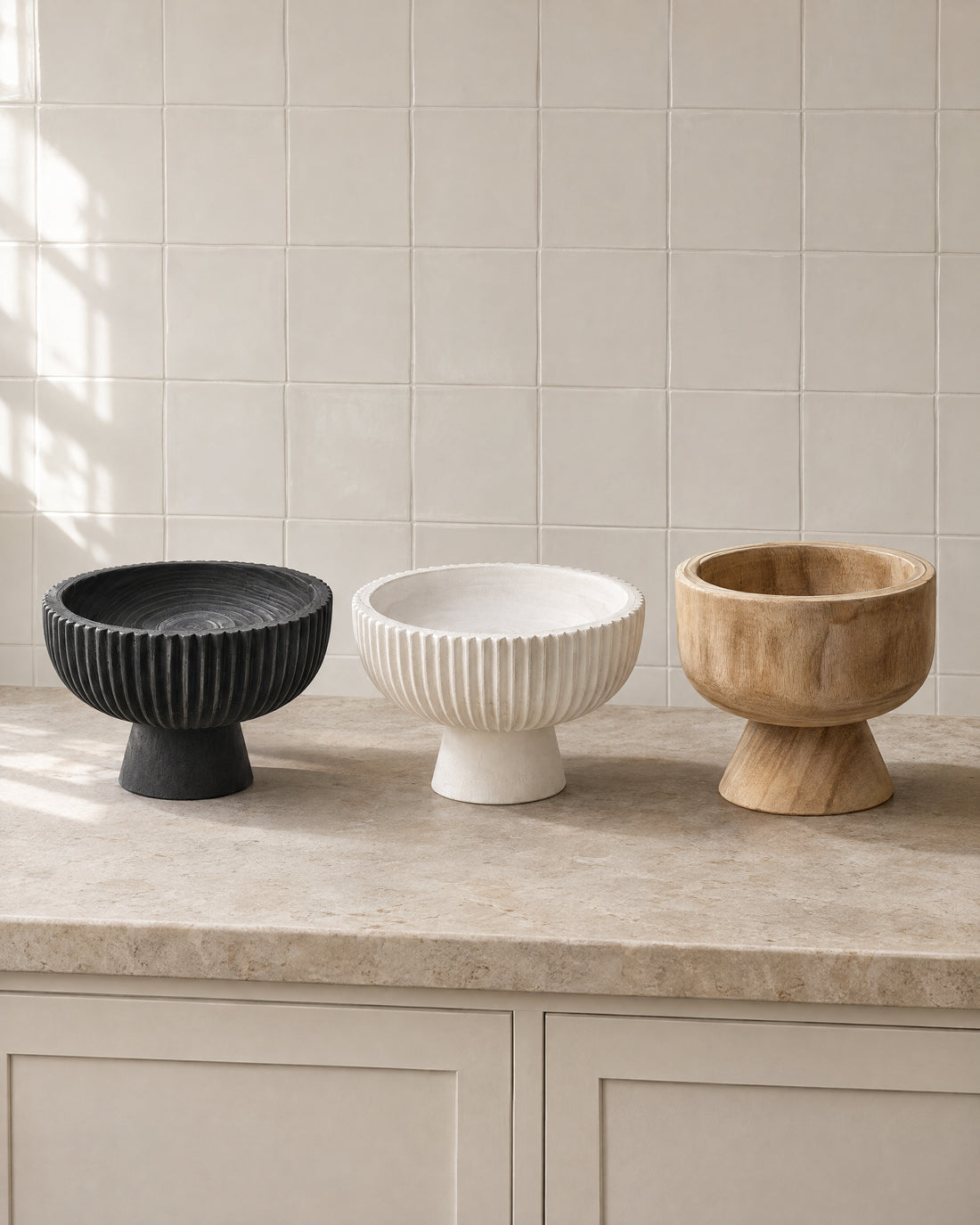
Our Rigato is a footed wooden bowl that comes both ways. The black and the white carry those grooves all around, running close together from the notched rim down toward the foot, while fine turned rings circle the inside. The third, in natural wood, keeps the same footed shape with smooth sides, so the grain of the wood is what you see. Human-centric design is necessarily haptic, treating the skin with a spectrum of smooth, textured, hard, soft, warm and cool sensations.
Ridged or smooth, each lifts what it holds above the rest of the table. Fill the white bowl with whole apples for the dining room, or set the natural bowl on a kitchen counter with a few lemons.
Vongola, a Bowl Shaped Like a Shell
In Latin, one word served for a shell and for a vessel: concha. Italian kept both meanings, in two words. A conca is still a wide basin, the kind used for washing laundry, and a vongola, from conchula, a little shell, is the clam that opens in a pan of spaghetti alle vongole.
We can find the basis for many feel-good designs in the natural world which is, after all, our evolutionary birthplace. Vongola takes its shape from the clam. It is a black wooden bowl whose rim lifts and dips in uneven waves, the way the edge of a shell does, and the grain carved inside curls along with it. No two rims rise and fall in the same places.
Pile whole pomegranates in it for the living room, or roll guest towels into it for a powder room.

Barchetta and the Ship at the Head of the Table
At the great tables of the late Middle Ages, you could find the seat of honor by looking for a ship. A nef was a small ship made of silver or gold, some of them raised on a foot, and it stood in front of the host or the most honored guest. It held that person's napkin, knife and spoon, or the salt.
Barchetta is Italian for a little boat, and for the paper boats children fold. Our Barchetta is a long, black wooden tray shaped like a boat, raised on a single tapered foot. Its outside is chiseled into small facets along its whole length, its rim rises and falls a little, and a cord of wooden beads ending in a jute tassel is tied where the foot meets the tray.
Run it down a long dining table with a row of whole persimmons, or place it at the head of the table, in front of the guest of honor, with the napkins rolled inside. All good works of architecture and design should serve the needs of the people they are made for.

Carciofo, Leaf Over Leaf
An artichoke is a flower that is picked before it opens. The part that reaches the kitchen is the bud: a fleshy base wrapped in thick bracts, which everyone calls leaves, each one overlapping the next. Carciofo is the Italian name for it, a word that came into Italian from the Arabic kharshuf.
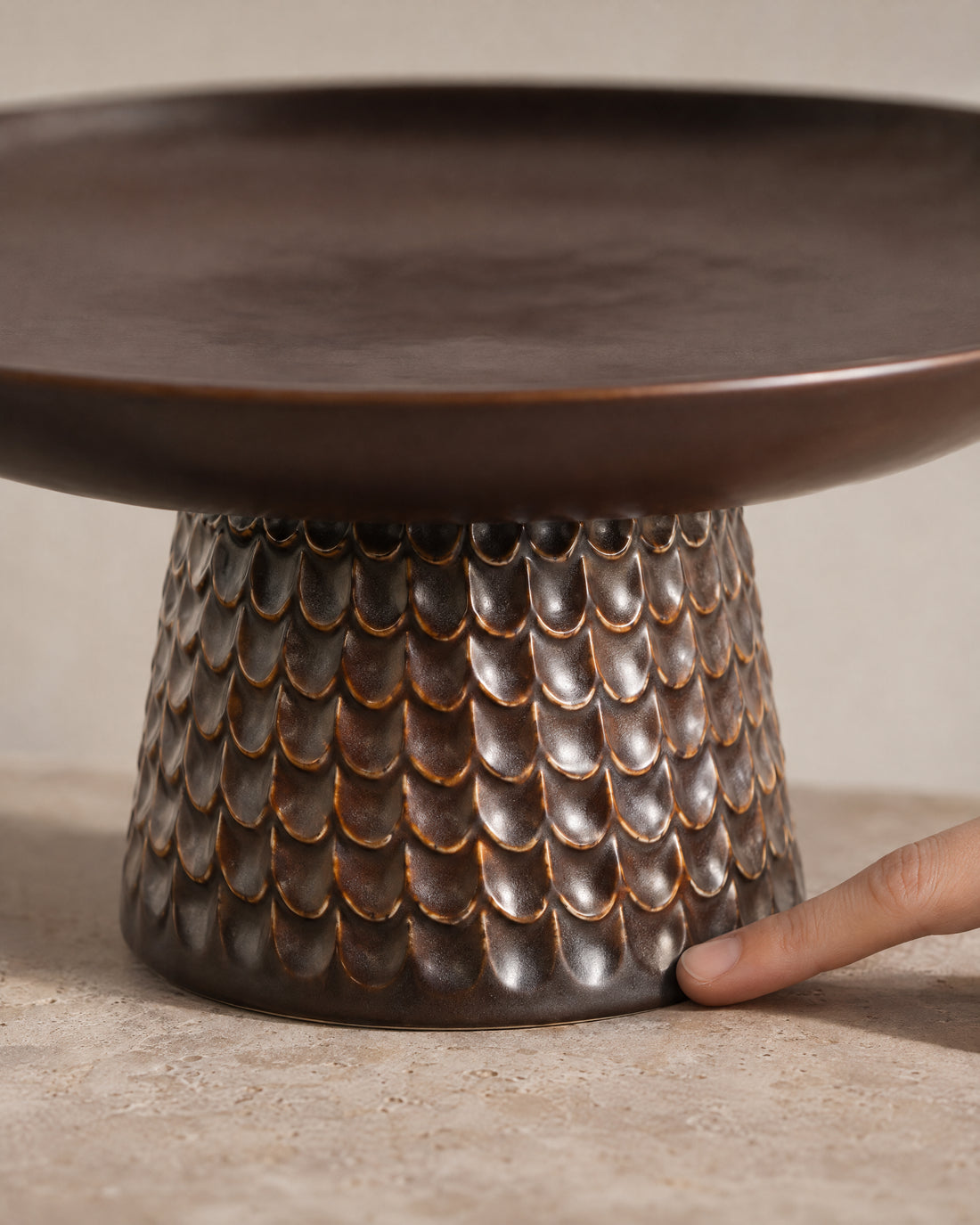
Organic shapes like these transcend the visual, the realm that trend-based designs momentarily satisfy, to instead attain enduring relevance through multisensory virtues that are instinctively appreciated. On Carciofo, the overlapping leaves become small raised scales covering the foot of the cup and of the large dish, under a dark brown glaze with a sheen like metal. Run a finger up the foot and you can feel each one. The medium dish rises on a smooth, flared foot instead, with a ring of white dots around its rim.
Fill the large dish with whole fruit for the dining table, and keep the small cup by the bed for rings.
Campana, the Bell That Became a Bowl
In Italian, bells ring a festa when a town has something to celebrate. Human-centric spaces try to conduct sounds that suggest life, allow communication to flow and ease spatial orientation. The dictionary describes the bell itself in plain words: a metal instrument shaped like an upturned cup, which sounds when it is struck.
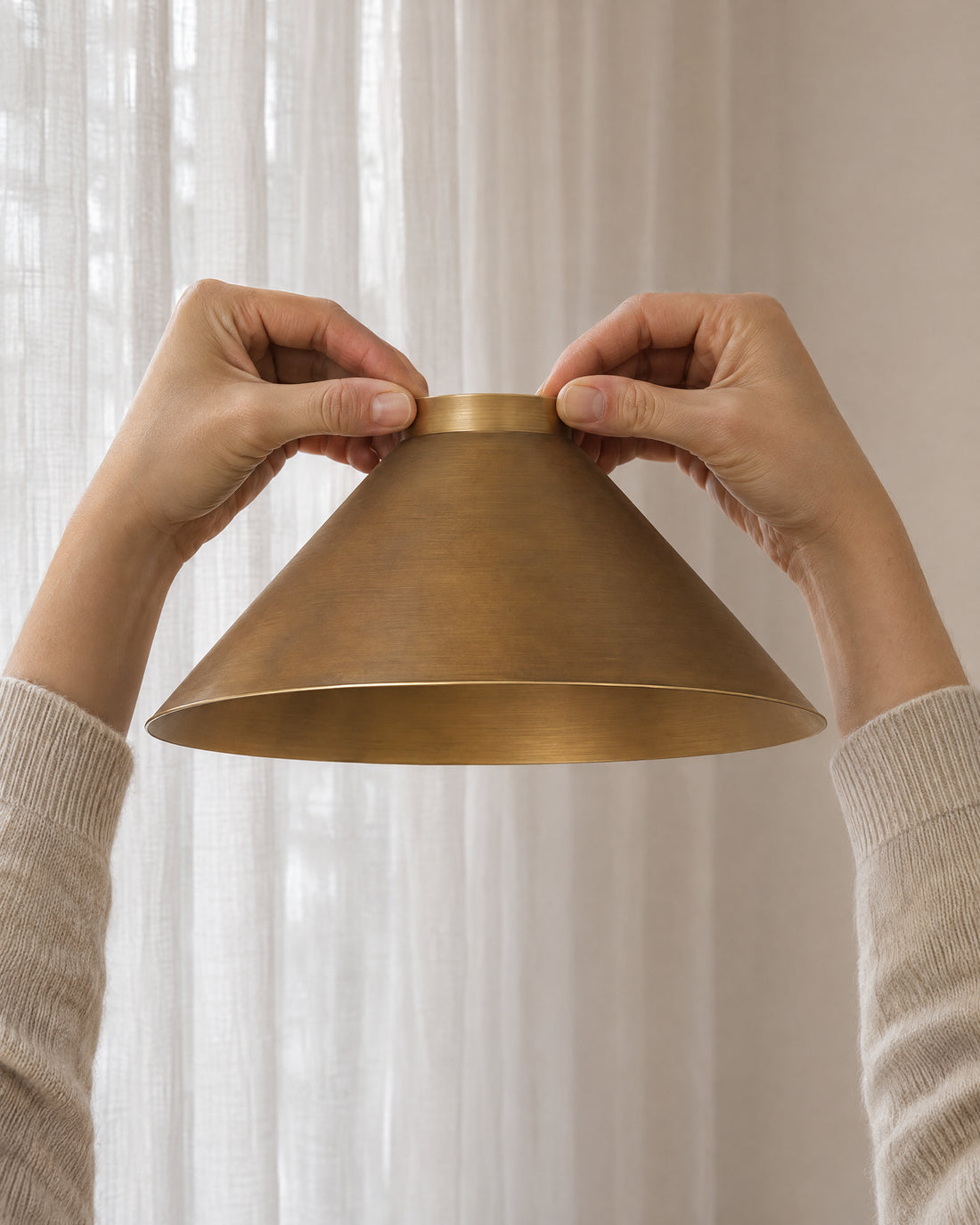
Campana, the Italian word for bell, is that same cup, standing on its foot. It is a wide metal bowl in the shape of a cone, narrowing to a small ring foot. The brass-colored finish is matte and softly mottled rather than polished, and the mottling falls a little differently on each one. Turn it over, holding it by the foot, and the bell is plain to see; set it back down and it is a bowl again.
Fill it with whole lemons on the kitchen table, or keep it by the front door to catch keys and coins when you come home.
Desco and the Tray for a New Mother
When a child was born in 15th-century Florence, the celebration often came with a painted wooden tray. It was called a desco da parto, a tray to celebrate a birth. Covered with a cloth, it carried food and sweets to the new mother while she rested, and afterward it was hung on the wall and kept, a reminder of the day. Past and present merge, and we feel simultaneously grateful for what has been and hopeful for what's to come.
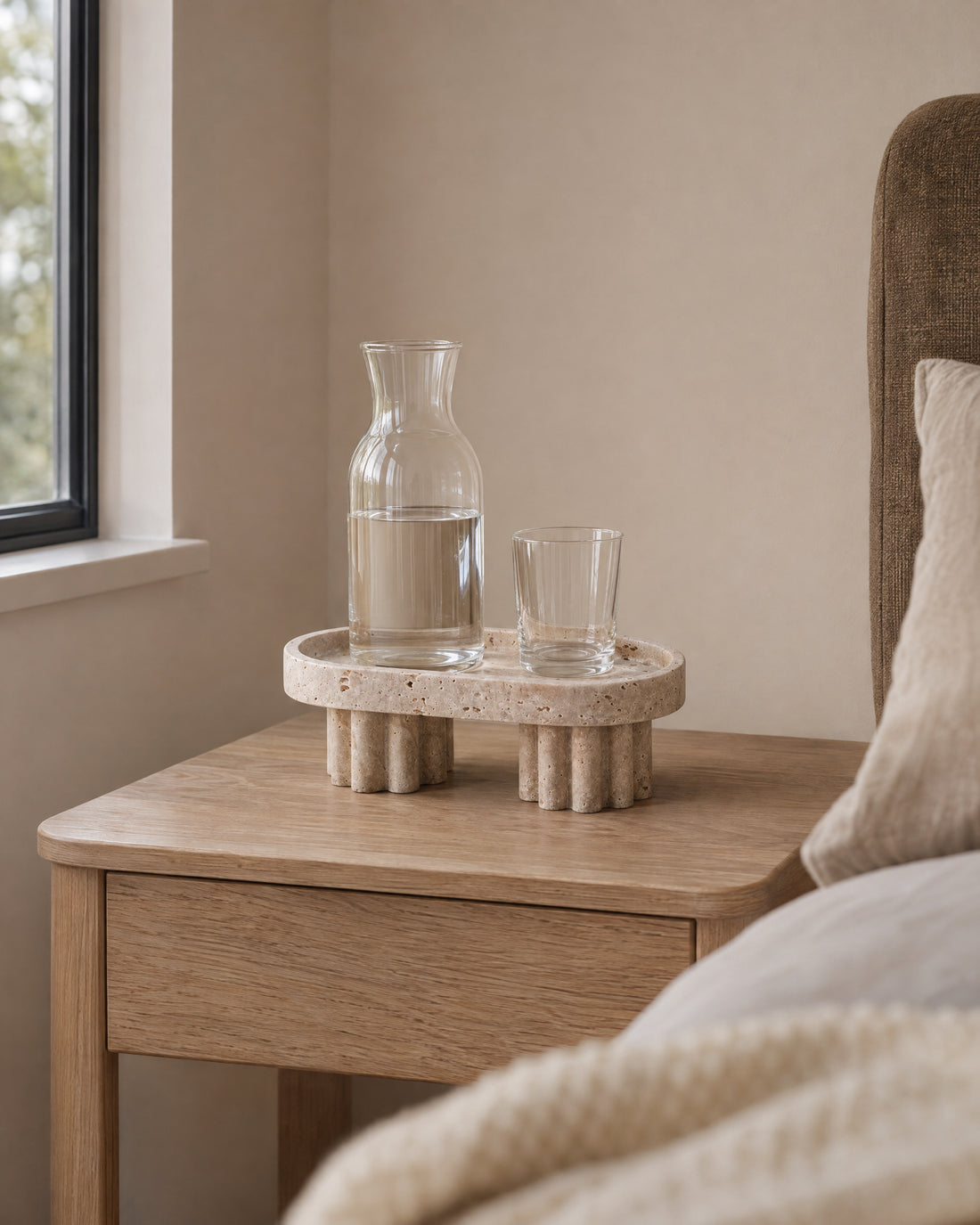
Desco is also the old Italian word for the table where people sit down to eat, from the Latin discus, a disc. Our Desco is a small table of that kind, made in stone: a round slab of travertine, a stone dotted with small natural holes, resting on a cluster of short round columns. A long oval slab rests on two clusters. Both are solid and heavy in the hand, and no two slabs share the same pattern of holes.
Set one on a dresser for a bottle of perfume and a dish of rings, or on a bookshelf under a small vase, so the vase stands apart from the books.
When an Italian family lived well, people used to say its bread trough, the madia, was always full.